
Sourcing Natrium Formate in 2026 takes more than comparing price per tonne. Buyers need to match the grade to its intended use, then verify purity, moisture limits, insoluble content, packaging, and delivery terms. A drum or big bag can look right on a quotation sheet. The certificate of analysis must confirm it.
Trade data helps establish a baseline, but it has limits. UN Comtrade’s HS 291512 category covers salts of formic acid; it may not distinguish Natrium Formate grades, production routes, or end uses. Treat its import and export figures as directional, and confirm the applicable customs classification with a qualified broker. For supplier screening, the OECD Due Diligence Guidance for Responsible Business Conduct offers a practical framework for checking business relationships and identifying supply-chain risks. These sources inform the process, but they do not replace a current supplier audit or independent product testing.
The buying decision should also account for delivery reliability. The World Bank’s Logistics Performance Index 2023 compares countries’ logistics capabilities, a useful context when evaluating shipping routes and lead-time risk. Ask suppliers for a recent batch-specific COA, safety data sheet, production location, and written specification. Request comparable quotations with the same Incoterm and packaging assumptions. Small differences matter. A low offer may exclude inland transport, sampling, or moisture protection. And sometimes the paperwork is incomplete. That is a reason to pause, not to guess. This guide explains how to compare suppliers, validate claims, and build a sourcing plan that remains practical in 2026.
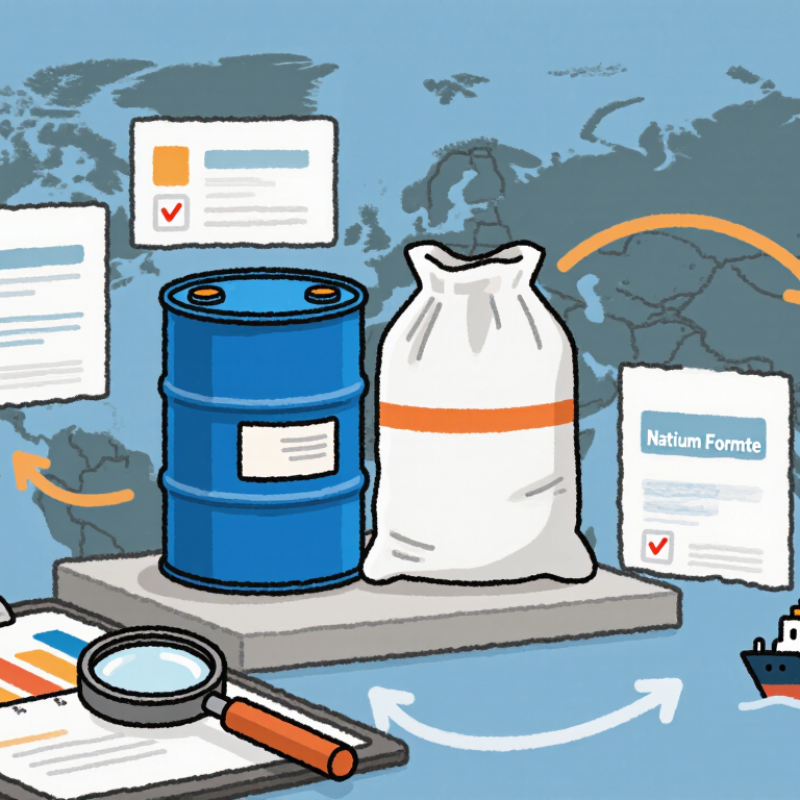
For sourcing natrium formate in 2026, start with its intended use. A process brine, de-icing blend, and laboratory application may need different grades. State the required assay and any limits for moisture, chloride, sulfate, iron, or other relevant impurities. Do not assume one specification fits every supplier. Small details matter.
Also define physical requirements. Specify powder or granule form, particle-size range, bulk density, and packaging size where these affect handling or dosing. Request a certificate of analysis for the offered lot, with test methods and results—not only typical values. Compare those results with your written acceptance limits. A neat spreadsheet can still hide a mismatch.
Tips: Ask for a recent sample and check how it dissolves under your actual operating conditions. Confirm packaging protects the material from moisture during storage and transport. Keep the agreed specification attached to the purchase record. One imperfect point: buyers sometimes focus on assay and overlook flow behavior; that can cause real trouble during feeding.
For 2026 sourcing, qualify the production site—not only the trading company. Sodium formate may come from direct neutralization of formic acid with sodium hydroxide or from a manufacturing co-product stream. Ask suppliers to identify the route, plant location, annual capacity, and backup arrangements. Request recent certificates of analysis showing assay, moisture, chloride, iron, and insoluble matter. Check whether results come from each production lot or a typical sample. That matters.
Use ECHA registration dossiers to cross-check substance identity and available technical information. UN Comtrade annual trade data can help compare import volumes and origins, but customs categories may group related products; they cannot confirm a supplier’s plant output. Compare several years rather than relying on one unusual shipment. Then verify capacity through site audits, production records, and sample testing under your own receiving method. Small discrepancies matter. A supplier may quote high purity, yet moisture or trace salts can affect storage and downstream use. Do not treat a polished data sheet as proof. Ask for traceable batch records, packaging specifications, and written change-control procedures. The public datasets are useful screening tools, not a substitute for direct verification.
How to Source Natrium Formate in 2026?
Verify Supplier Credentials, Product Quality, and Regulatory Compliance
Sourcing sodium formate is more than comparing price per tonne. Verify the supplier’s legal business identity, manufacturing site, and quality-system certificates. Check that certificates are current and cover the actual production facility. UNEP’s Global Chemicals Outlook II reports that global chemical sales grew from US$1.2 trillion in 2000 to US$5.7 trillion in 2017. That scale makes careful supplier checks essential. Paperwork can mislead.
Request a recent certificate of analysis for the specific lot, not just a typical specification sheet. Compare assay, moisture, and relevant impurities against your process requirements. Where practical, test a retained sample through an independent laboratory. Review the safety data sheet, product label, and transport details, then confirm they match the destination market’s requirements. Requirements differ by market. A polished certificate alone cannot establish consistent product quality.
Tips: Ask for traceability from production lot to shipment, and confirm how deviations and complaints are handled. Check certificate validity with the issuing body. One weak point in many purchasing checklists is relying on documents without checking the material itself. Test the lot.
| Assessment Area | What to Verify | Evidence to Request or Check | Practical Acceptance Guidance |
|---|---|---|---|
| Product identity | Sodium formate, also known as sodium methanoate; formula CHNaO2; CAS No. 141-53-7; molar mass approximately 68.01 g/mol. | Current technical data sheet (TDS), safety data sheet (SDS), product label, and batch certificate of analysis (CoA). | Confirm that the chemical name, CAS number, formula, physical form, and grade match the intended application across all documents. |
| Supplier credentials | Legal business identity, manufacturing or distribution role, quality-management arrangements, and ability to trace supplied material to a production batch. | Business registration details, manufacturing-site information, quality-system certificate where claimed, and documented traceability or change-control procedures. | Check that certificates are current, apply to the relevant site and activity, and can be independently verified with the issuing organization. |
| Grade and intended use | Whether the offered material is industrial, laboratory, or another specified grade; suitability depends on the application and required impurity limits. | Grade-specific specification, TDS, CoA, and written confirmation of intended-use suitability. | Do not treat grades as interchangeable. Agree on the required specification and application before placing an order. |
| Assay and composition | Declared sodium formate content and the basis used for the result, such as as-received or dry basis. | Recent batch CoA showing the test result, specification limit, test method, and reporting basis. | Set acceptance limits in the purchase specification. Limits are application-specific; do not assume a universal assay value. |
| Impurities and moisture | Relevant impurities may include chloride, sulfate, iron, other metals, and water, depending on the process and grade required. | Batch CoA with agreed impurity tests and methods. Moisture may be measured using a validated method such as Karl Fischer titration or loss on drying, as appropriate. | Specify only the impurities that matter to the application, with agreed limits and methods. Confirm that the method is suitable for the product matrix. |
| Testing and batch consistency | Whether test methods are documented and results are representative of the shipped batch. | CoA linked to the batch or lot number; method references; sampling procedure; and, where risk warrants, an independent laboratory report. | Match the lot number on the CoA, packaging, and shipping documents. Establish incoming-testing and out-of-specification procedures. |
| Safety documentation | Current SDS content, including identification, hazards, handling, storage, first aid, exposure controls, and transport information. | Country- and language-appropriate SDS prepared in the applicable format, plus compliant product labeling. | Review the SDS for the destination market and intended use. Do not rely on an SDS from a different product grade or jurisdiction. |
| Regulatory compliance | Applicable chemical inventory, registration, notification, and hazard-communication duties depend on the importing country, supply-chain role, volume, and use. | Written confirmation of relevant obligations and supporting documentation for the destination market. In the EU, review REACH Regulation (EC) No 1907/2006 and CLP Regulation (EC) No 1272/2008. In the US, check applicable TSCA and OSHA Hazard Communication requirements. | Verify requirements with the importer or a qualified regulatory specialist. A supplier statement alone does not replace the responsible party’s legal checks. |
| Packaging, storage, and transport | Packaging compatibility, closure and moisture protection, storage conditions, shelf-life or retest period, and transport classification for the shipment route. | Packaging specification, label details, storage guidance, shelf-life statement, and applicable transport information in the SDS and shipping documents. | Confirm packaging and transport requirements for the actual destination and mode. Avoid assuming a classification or storage condition without checking current shipment documents. |
| Commercial and supply continuity | Quoted grade and specification, minimum order quantity, lead time, origin, available lot size, and contingency arrangements. | Written quotation, product specification attached to the order, delivery terms, and documented notice process for changes in source, process, or specification. | Make the agreed specification and change-notification requirements part of the purchase documentation. Requalify material after significant changes. |
| Pre-shipment review | Consistency among the order, product label, CoA, SDS, and shipping documents. | Pre-shipment document pack with product name, CAS number, grade, lot number, quantity, and destination details. | Resolve discrepancies before dispatch and retain approved documents and representative batch records for traceability. |
Sourcing natrium formate in 2026 starts with a comparable specification, not the lowest quote. Ask each supplier to state assay, moisture limit, grade, packaging, and delivery location. These details can change the usable cost. A price per metric ton may exclude freight, insurance, handling, or testing. Compare delivered costs on the same basis, and request a quote validity period because transport and input costs can shift. A spreadsheet helps.
Minimum order quantities vary with production schedules, bag size, and shipping method. A pallet may have a higher unit price than a full truckload. But oversized orders can tie up cash and storage space. Check whether samples, mixed pallets, or staged deliveries are available. Small buyers should also confirm storage requirements; cheaper bulk material is not automatically economical. Ask about packaging options.
Contract terms deserve equal attention. Confirm payment milestones, lead time, delivery tolerances, quality documents, and the process for handling off-spec material. Define how shortages or delays are communicated, and whether price changes can reopen a fixed-term agreement. Keep the wording specific. One limitation is easy to overlook: a quote is only a snapshot. Verify supplier claims with current documents and, where appropriate, independent testing. That check can take time.
For a 2026 sodium formate purchase, request a sample from the same production lot proposed for shipment. Ask for a current certificate of analysis and safety data sheet. Check the sample’s appearance, assay, moisture level, and insoluble matter against your process specifications. If possible, have your own laboratory verify the critical values. A neat sample alone proves little; I would not skip lot-level checks, even when a supplier’s paperwork looks complete.
Before ordering, confirm the package size, liner material, pallet arrangement, and protection from rain during loading. Ask the freight provider how the cargo will be handled and whether shipment documents match the product and quantity. Sodium formate can cake when exposed to moisture, so inspect bags or drums on arrival for tears, damp patches, or hardened material. Store unopened packages in a cool, dry area, off the floor and away from water. Keep the original labels visible, and reseal opened containers promptly. Storage conditions are easy to overlook.
Tips: Photograph packages at delivery, record lot numbers, and retain a sealed sample. If results differ from the paperwork, pause use and investigate before blending the material.
Approximate literature values show sodium formate becomes more soluble as water temperature rises. When evaluating a sample, confirm identity and purity against its certificate of analysis and test it under your process conditions. For shipping and storage, check the supplier’s safety documentation and keep the solid dry in a tightly sealed package.