What is a Caesium Clock and How Does It Work?
In the realm of timekeeping, the Caesium Clock stands out as a marvel of precision. Dr. Isabelle Martin, a leading expert in atomic timekeeping, emphasizes, "The Caesium Clock is the heartbeat of modern technology." It uses the vibrations of cesium atoms to measure time extremely accurately. This technology is crucial for GPS systems and telecommunications.
The Caesium Clock operates by counting the oscillations of cesium atoms in a defined state. Each oscillation represents a second, with incredible stability. However, even this remarkable technology is not without flaws. Variations in atomic behavior can lead to unexpected discrepancies.
As we explore the Caesium Clock, we recognize its significance for both science and daily life. While it defines how we measure time, it also prompts questions about accuracy. Is absolute precision achievable? Dr. Martin’s work reminds us that even in perfection, reflection on our methods is vital. The quest for timekeeping continues, with the Caesium Clock at its core.
What Is a Caesium Clock?
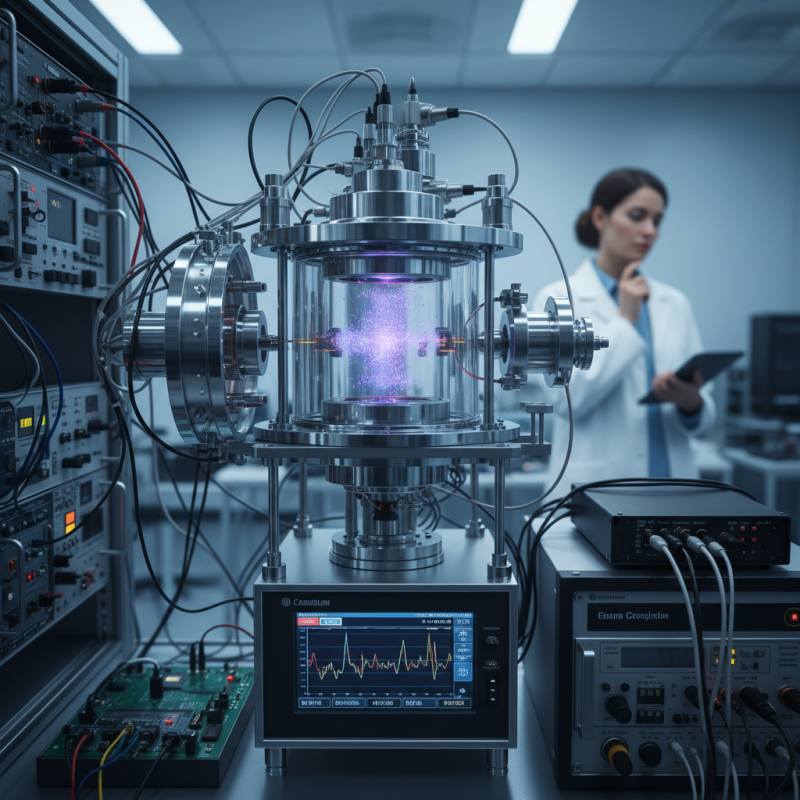
A caesium clock is a type of atomic clock that is highly accurate. It uses the vibrations of caesium atoms to measure time. These atoms resonate at a specific frequency when exposed to microwave radiation. This frequency is incredibly stable, making it perfect for timekeeping.
The heart of the caesium clock is a chamber filled with caesium gas. When microwaves hit the atoms, they jump to a higher energy level. This leap happens exactly 9,192,631,770 times per second. This precise measurement defines the second in the International System of Units (SI). As a result, caesium clocks can keep time to within a few billionths of a second.
Tips: Maintaining a caesium clock requires a clean environment. Even small particles can disrupt measurements. Regularly check the microwave frequency. Slight adjustments can enhance accuracy.
While caesium clocks are amazing, they still have limitations. They depend on temperature and pressure. Any changes can affect atom behavior. This might lead to slight inaccuracies. Hence, regular calibration is essential for optimum performance.
History and Development of Caesium Clocks
The history of caesium clocks dates back to the mid-20th century. In 1955, the first operational caesium atomic clock was built. This landmark event paved the way for precise timekeeping. Scientists needed more accuracy than mechanical clocks could provide. The caesium clock offered a solution.
By using the vibrations of caesium atoms, these clocks achieved unprecedented accuracy. A caesium clock can maintain an error of less than one second over millions of years. According to a 2021 report from the National Institute of Standards and Technology (NIST), modern caesium atomic clocks are so precise that they only drift by about one second every 15 million years. This level of precision underlines the significant advancements made since their inception.
However, challenges have arisen over the years. The reliance on caesium has led to questions about the future of timekeeping. Researchers are exploring optical lattice clocks, which may offer even greater accuracy. The pursuit of perfect time continues to drive innovation. Progress in this field illustrates the balance between tradition and modern technology. Finding the next leap in precision is both exciting and daunting.
Development of Caesium Clocks Over Time
This bar chart illustrates the improvement in precision of caesium clocks over the decades, showcasing how technological advancements have dramatically enhanced the accuracy of timekeeping. The data represents the precision of caesium clocks measured in seconds lost or gained per day from 1955 to 2020.
Principles of Operation in Caesium Atomic Clocks
Caesium atomic clocks are fascinating. They use the vibrations of caesium atoms to keep time. The core principle relies on the natural frequency of cesium-133. This isotope vibrates at 9,192,631,770 times per second.
When cesium atoms are exposed to microwave radiation, they absorb energy. This process allows the atoms to move to a higher energy state. The clock measures these transitions. This is where accuracy shines. Atomic clocks can achieve a precision of one second in millions of years. According to the National Institute of Standards and Technology, this accuracy is crucial for GPS technology and telecommunications.
However, challenges remain. Environmental factors can influence performance. Temperature and magnetic fields might cause small errors. Researchers are continually exploring ways to improve stability and reduce these errors. Some ongoing projects aim to use optical lattices for better precision. This opens doors to even more accurate timekeeping methods. The quest for perfection in time measurement is ongoing.
Applications of Caesium Clocks in Modern Technology
Caesium clocks are vital in modern technology. They are the gold standard for accurate timekeeping. These clocks operate on the frequency of microwave radiation emitted or absorbed by caesium atoms. When caesium oscillates, it defines the second. This precision is astonishing, with an accuracy of one second in millions of years.
Their applications are widespread. Global positioning systems (GPS) rely heavily on caesium clocks. They synchronize satellite signals, allowing for pinpoint accuracy in navigation. A slight time error of just a few nanoseconds can lead to significant location inaccuracies. Reports indicate that precise timing impacts the efficiency of telecommunications. Slow signals can degrade data transmission rates.
However, the reliance on caesium clocks has its flaws. Many industries face challenges due to the physical limitations of these devices. For instance, as technologies evolve, the demand for smaller and more efficient timekeeping devices increases. Traditional caesium clocks are large and expensive. Innovations are necessary to keep up with modern needs. Researchers are exploring alternatives like optical lattice clocks, promising even greater precision. But the transition is slow, and the established standards can be hard to change.
Future Perspectives and Advances in Timekeeping Technology
The advancements in timekeeping technology are paving the way for innovative solutions in precision surveying, telecommunications, and navigation. The caesium clock demonstrates reliability. It achieves an accuracy that can measure time to within a second over millions of years.
Experts predict that by 2030, next-generation atomic clocks may reach quantum levels of precision. A report from the National Institute of Standards and Technology suggests that future clocks could utilize optical lattice technology. This could improve time measurement accuracy by several orders of magnitude. Such precision has implications for GPS systems, potentially reducing location errors to less than a millimeter.
Despite these promising advances, challenges remain. The complexity of integrating new technologies can hinder widespread adoption. Manufacturers must address costs associated with producing highly precise clocks. These costs may limit access to advanced timekeeping technology for various sectors. As we consider the future, it is essential to navigate the fine line between innovation and feasibility.